Aperçu
Un pipeline de données IA est un système automatisé qui ingre, prépare et fournit des données structurées et non structurées pour entraîner, mettre en place et exploiter des modèles d’intelligence artificielle et d’apprentissage automatique. Contrairement aux pipelines de données traditionnels conçus pour les tableaux de bord et les rapports, les pipelines de données IA sont conçus pour des données multimodales, des exigences de lignée plus strictes et les cycles de réentraînement continus que les charges de travail modernes d’IA exigent.
Un pipeline de données d’IA bien conçu fait circuler les données à travers cinq étapes distinctes — ingestion, préparation, entraînement ou indexation, déploiement et surveillance — chacune conçue spécialement pour maintenir les modèles précis, gouvernés et prêts à la production.
Qu’est-ce qu’un pipeline de données IA ?
Un pipeline de données d’IA est l’infrastructure automatisée qui transplace les données de ses systèmes sources vers une forme que l’intelligence artificielle et les modèles d’apprentissage automatique peuvent utiliser. Il est responsable d’ingérer les données brutes, de les nettoyer et de les transformer, puis de les livrer — au bon moment, dans le bon format — aux modèles qui en dépendent. En production, le pipeline ne s’arrête pas une fois les données livrées. Il continue de surveiller le comportement des modèles, de détecter les dérives et de renvoyer les données fraîches dans l’entraînement, fermant ainsi la boucle entre la plateforme de données et les applications d’IA qu’elle supporte.
L’essor de l’IA en entreprise a changé ce qu’un pipeline est censé faire. Un pipeline de données traditionnel est optimisé pour déplacer des lignes de données structurées dans un entrepôt pour analyse. Un pipeline de données d’IA est optimisé pour quelque chose de plus large. Il doit accueillir des sources non structurées telles que des documents, des images, de l’audio et de la télémétrie en streaming ; générer des embeddings pour la génération augmentée par la récupération (RAG) ; suivre suffisamment bien la lignée pour reproduire une exécution d’entraînement de modèle spécifique ; et maintenir la fraîcheur dont dépendent les charges de travail d’inférence. Ces exigences distinguent un pipeline d’IA moderne de ses prédécesseurs — et pourquoi la plupart des entreprises estiment que leurs pipelines de données existants doivent être étendus, et non remplacés, pour supporter l’IA.
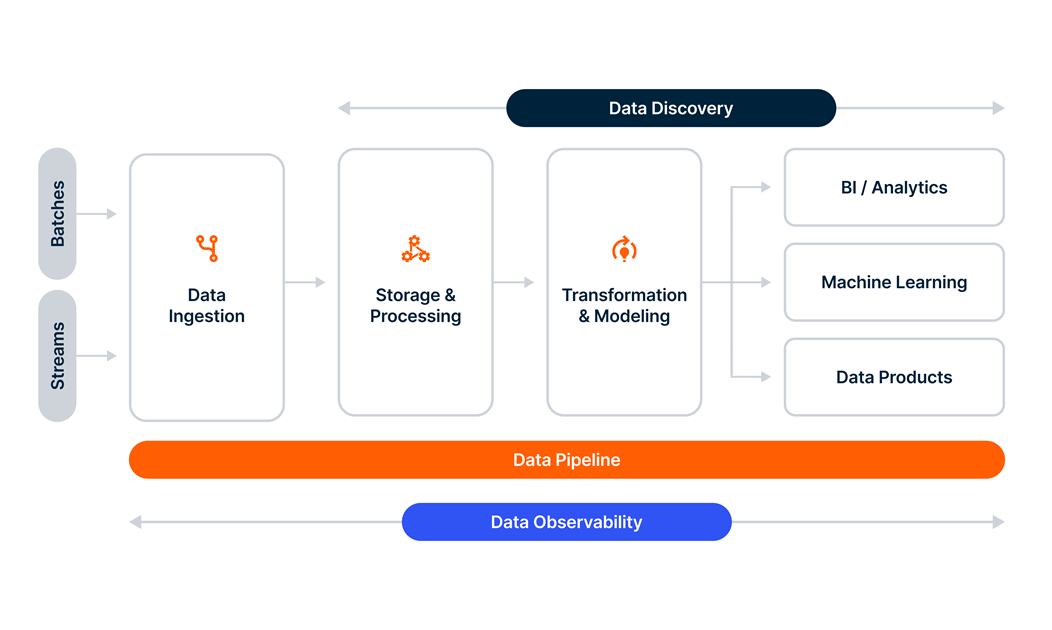 Source : https://www.montecarlodata.com/blog-data-pipeline-architecture-explained
Pipeline IA vs. pipeline ML vs. pipeline de données
Les termes pipeline de données, pipeline ML et pipeline de données IA sont souvent utilisés de manière interchangeable, mais ils décrivent différents champs de travail. Un pipeline de données est la catégorie parente : tout flux automatisé qui déplace les données de la source à la destination. Un pipeline ML est un concept plus restreint, faisant généralement référence à la séquence d’étapes qui transforme les données d’entraînement en un modèle d’apprentissage automatique déployé — ingénierie des fonctionnalités, entraînement, validation et déploiement.
Un pipeline de données IA est plus large que les deux. Il englobe l’ensemble du parcours allant des données sources brutes à une application d’IA en production, incluant le pipeline ML comme une étape unique. Un pipeline de données IA va également au-delà de l’apprentissage automatique classique pour supporter les charges de travail d’IA générative, où les pipelines alimentent des magasins vectoriels pour RAG plutôt que des magasins de fonctionnalités pour les modèles prédictifs. Traité ainsi, le pipeline de données IA est le tissu de connexion entre la plateforme de données d’entreprise et toutes les applications IA construites dessus.
Les 5 étapes d’un pipeline de données d’IA
La plupart des pipelines de données IA, quelle que soit la plateforme sur laquelle ils fonctionnent ou les modèles qu’ils supportent, suivent les mêmes cinq étapes. Les noms exacts varient selon les fournisseurs et les frameworks, mais le travail effectué à chaque étape est cohérent : les données sont ingérées, préparées, utilisées pour entraîner ou ancrer un modèle, déployées dans une application, puis surveillées pour que le cycle puisse se poursuivre.
Étape 1 : Ingestion des données
L’ingestion est le point où le pipeline collecte des données brutes de ses systèmes sources. Pour les charges de travail IA, ces sources sont exceptionnellement diverses. Elles peuvent inclure des bases de données transactionnelles, des flux d’événements, de la télémétrie IoT, des dépôts de documents, des images, des journaux et des API tierces. L’ingestion de données IA diffère de l’ingestion traditionnelle par sa tolérance à la variété de formats et par sa nécessité de gérer à la fois les entrées batch et en streaming dans le même pipeline. Selon le cas d’usage, l’ingestion peut être planifiée, continue ou déclenchée par des événements en amont — et un pipeline de niveau entreprise prend généralement en charge les trois modèles simultanément.
Étape 2 : Préparation et prétraitement des données
Une fois ingérées, les données doivent être préparées avant de pouvoir être utilisées par un modèle. Cette étape gère le nettoyage, la déduplication, la normalisation, la conversion de types et toute transformation nécessaire pour donner une forme cohérente à des sources disparates. Pour les charges de travail en apprentissage automatique, la préparation inclut également l’ingénierie des caractéristiques — dériver les variables dont un modèle apprendra. Pour les charges de travail en IA générative, la préparation s’étend à découper de longs documents en passages récupérables et à générer des embeddings vectoriels pouvant être indexés pour la recherche sémantique. La préparation est généralement l’étape la plus coûteuse en calcul du pipeline et souvent la plus chronophage à construire et à maintenir.
Étape 3 : entraînement des modèles ou indexation RAG
À ce stade, des données préparées sont utilisées pour construire ou ancrer le modèle. Pour l'apprentissage automatique traditionnel, l'entraînement consiste à faire passer les données à travers un algorithme pour produire un modèle capable de faire des prédictions sur de nouvelles entrées, soutenu par un magasin de fonctionnalités qui conserve des caractéristiques cohérentes à travers l'entraînement et l'inférence. Pour l'IA générative, cette étape prend une forme différente : au lieu d'entraîner un modèle de base à partir de zéro, les données préparées sont chargées dans un stockage vectoriel ou un index de récupération, où elles peuvent être utilisées pour ancrer les réponses d'un modèle existant dans le contexte d'entreprise. Les deux chemins convergent sur la même exigence — les données utilisées à ce stade doivent être strictement versionnées, entièrement traçables et reproductibles.
Étape 4 : Déploiement et service
Une fois qu'un modèle a été entraîné ou qu'un index a été construit, il passe en production. Le déploiement est le transfert de l'environnement d'entraînement à l'infrastructure de service que les utilisateurs finaux ou les applications appelleront. Pour les modèles prédictifs, cela signifie exposer les points d'inférence et s'assurer que les mêmes fonctionnalités disponibles pendant l'entraînement sont disponibles en production. Pour l'IA générative, cela signifie rendre la logique de stockage et de récupération vectorielle accessible à la couche application. Le déploiement est aussi le moment où les exigences de fraîcheur et de latence du pipeline deviennent non négociables : les utilisateurs et les applications remarquent immédiatement les données obsolètes et les réponses lentes.
Étape 5 : Surveillance et observabilité
La dernière étape est celle où le pipeline gagne son intérêt au fil du temps. La surveillance couvre à la fois la santé du pipeline — les tâches en cours d’exécution, l’arrivée des données, le respect des SLA — et la santé du modèle, y compris la dérive des données, la dérive de prédiction et la dégradation de la précision. L’observabilité dans un pipeline d’IA dépasse ce qui est requis pour un pipeline de données traditionnel car les modes de défaillance sont plus subtils : un modèle peut continuer à produire une sortie qui semble normale tout en perdant silencieusement sa précision à mesure que la distribution des données sous-jacente évolue. La surveillance est aussi ce qui referme la boucle à l’ingestion et à l’entraînement, en envoyant des signaux de réentraînement et de nouvelles données dans le cycle suivant.
Pipeline de données IA vs. pipeline de données traditionnel
Un pipeline de données traditionnel et un pipeline de données d’IA partagent les mêmes éléments de base — ingestion, transformation, stockage et livraison — mais ils sont conçus pour des résultats différents. Un pipeline traditionnel existe pour produire un rapport, un tableau de bord ou un tableau prêt à être interrogé. Son succès se mesure à la fiabilité avec laquelle il fournit des données structurées et sélectionnées aux analystes humains selon un calendrier prévisible. Un pipeline de données d’IA, en revanche, existe pour produire un modèle performant en production. Son succès se mesure à la précision du modèle, à la qualité de la mise à la terre et à la rapidité avec laquelle de nouvelles données peuvent être reflétées dans les deux.
Cette différence façonne presque toutes les décisions de conception en aval. Les pipelines traditionnels privilégient la rigueur schéma sur écriture car les analystes ont besoin de colonnes cohérentes ; Les pipelines d’IA privilégient la flexibilité des schémas car un jeu de données d’entraînement utile s’appuie souvent sur des documents, des images et des journaux qui résistent aux schémas fixes. Les pipelines traditionnels sont généralement planifiés ; les pipelines d’IA sont généralement continus, car les modèles se dégradent sans données fraîches. Les deux modèles ne sont pas en concurrence — ils sont complémentaires. La plupart des entreprises exécutent des pipelines traditionnels pour servir leurs charges d’analyse et des pipelines de données IA pour servir leurs charges de modèle, le pipeline d’IA étendant et réutilisant la gouvernance, le stockage et la lignée que le pipeline traditionnel fournit déjà.
Utilisez un pipeline de données traditionnel lorsque :
- Les consommateurs sont des tableaux de bord, des rapports ou des analyses opérationnelles
- Les données sont principalement structurées et le schéma est stable
- La cadence de rafraîchissement est planifiée et prévisible
- La conformité et l’auditabilité sont les principales exigences de gouvernance
Utilisez un pipeline de données IA lorsque :
- Les consommateurs sont des modèles d’apprentissage automatique, de grands modèles de langage ou des applications d’IA
- Les données incluent du contenu non structuré ou multimodal tel que texte, images, audio ou documents
- Les modèles nécessitent un réentraînement continu ou une mise à la terre en temps réel
- L’audit de lignée du modèle et de réentraînement est requis en parallèle de l’audit standard des données
Architecture du pipeline de données IA
Il n'existe pas d'architecture unique et correcte pour un pipeline de données IA. La bonne conception dépend du profil de charge de travail — si le pipeline supporte la modélisation prédictive, l'IA générative, ou les deux ; si l'inférence est en temps réel ou batch ; et la stricteur des contraintes de gouvernance et de coûts de l'entreprise. La plupart des pipelines d'IA en production combinent plusieurs schémas architecturaux plutôt que de s'engager dans l'un d'eux.
Patterns batch, streaming et hybrides
Les pipelines batch déplacent de grands volumes de données selon un calendrier et sont bien adaptés à l’entraînement de modèles, où la cohérence compte plus que la fraîcheur. Les pipelines de streaming déplacent les données en continu et sont bien adaptés aux fonctionnalités d’inférence, où un modèle servant une application en direct a besoin du signal le plus récent disponible. La plupart des systèmes d’IA réels utilisent un pattern hybride, parfois appelé architecture lambda ou kappa, dans lequel un chemin de streaming gère les besoins en temps réel et un chemin batch gère des agrégations historiques plus profondes. Un pattern hybride est plus complexe à exploiter mais reflète la forme réelle de la plupart des charges de travail d’IA d’entreprise, où ni le pur batch ni le pur streaming ne suffisent à eux seuls.
Considérations de stockage et de calcul
Les pipelines d’IA touchent un éventail plus large de systèmes de stockage que les pipelines traditionnels. Les données brutes tombent généralement dans le stockage d’objets. Les données analytiques gouvernées sont stockées dans un entrepôt de données ou un lakehouse. Les fonctionnalités d’apprentissage automatique sont gérées dans un magasin de fonctionnalités afin que les mêmes fonctionnalités soient disponibles à la fois pendant l’entraînement et l’inférence. Les charges de travail en IA générative ajoutent un stockage vectoriel à la liste, où les embeddings sont indexés pour la récupération. Côté calcul, les étapes d’entraînement reposent de plus en plus sur le matériel GPU ou accélérateur, tandis que les étapes de service peuvent mélanger inférence basée sur CPU, inférence basée sur GPU et appels de génération augmentés par récupération vers des modèles fondateurs externes. Les décisions architecturales à cette couche ont des implications directes sur les coûts et figurent parmi les plus difficiles à modifier une fois en production.
Gouvernance, lignée et contrôles d’accès
La gouvernance dans un pipeline de données IA n’est pas une superposition — c’est une propriété de conception. Chaque étape du pipeline doit répondre à trois questions : quelles données ont été utilisées, quelles transformations ont été appliquées, et qui est autorisé à accéder à la sortie. Data Lineage suit les deux premières. Les contrôles d’accès appliquent le troisième. Model Lineage étend ces exigences en liant une version spécifique du modèle à la version de données et à l’exécution du pipeline qui l’ont produite, ce qui rend les entraînements reproductibles et le comportement du modèle auditable. Dans les industries réglementées, la gouvernance à cette profondeur n’est pas optionnelle. Dans chaque secteur, c’est la différence entre un pipeline fiable en production et un pipeline qui ne le peut pas.
Construire des pipelines de données IA de niveau entreprise
C’est en déplaçant un pipeline de données IA du prototype à la production que la plupart des initiatives d’IA découvrent leurs véritables défis. Un pipeline fonctionnant sur un ordinateur portable avec des échantillons propres se comporte très différemment lorsqu’on lui demande de gérer des volumes à l’échelle de l’entreprise, des données régulées et des modèles nécessitant une rééducation continue. Les pipelines d’IA de niveau entreprise se distinguent moins par les outils qu’ils utilisent que par les disciplines qu’ils imposent.
Qualité des données et préparation
Un modèle n’est aussi bon que par les données sur lesquelles il est entraîné et fondé. Les contrôles de qualité des données doivent être intégrés directement dans le pipeline, et non appliqués comme une étape séparée après coup. Pour les charges de travail de l’IA, la qualité dépasse les dimensions traditionnelles telles que l’exhaustivité et la précision. Elle inclut les contrôles de biais, la représentativité des échantillons d’entraînement et la récentité — garantissant que les données reflètent le monde dans lequel le modèle va fonctionner. Un pipeline qui transmet silencieusement des données de faible qualité à un modèle produit un modèle qui sous-performe silencieusement.
Lignée modèle et gouvernance
La reproductibilité est ce qui distingue un système d’IA de production d’une démonstration. Savoir exactement quelle version des données d’entraînement, quelle transformation et quel pipeline a produit un modèle donné est un problème d’ingénierie non trivial — l’entraînement introduit un non-déterminisme que la lignée des données ordinaire n’a pas à prendre en compte. Les pipelines de niveau entreprise considèrent la lignée du modèle comme un artefact de première classe, lié à la lignée des données qui l’a produit et à l’enregistrement de déploiement qui l’a mis en production. C’est ce qui permet à un modèle d’être audité, rétrogradé et réentraîné avec confiance.
Prévisibilité des coûts et cadence de rééducation
Les coûts des pipelines IA sont plus difficiles à prévoir que ceux des pipelines traditionnels car ils incluent une utilisation variable du GPU, le volume d’inférence et le coût des appels de modèles fondateurs externes. La cadence de réentraînement est le levier de coût le plus important que la plupart des équipes ont : la formation gaspille trop souvent le calcul, la formation permet trop rarement de se dégrader la précision. Un pipeline de niveau entreprise fait de la cadence de réentraînement une décision de conception explicite plutôt qu’une habitude opérationnelle, et elle instrumentalise côte à côte coût et précision afin que le compromis puisse être géré intentionnellement.
Sécurité et contrôles d’accès
Les données d’entraînement contiennent souvent les informations les plus sensibles de l’organisation — dossiers clients, historiques de transactions, documents internes et connaissances propriétaires. L’accès aux données d’entraînement mérite la même rigueur que l’accès à la base de données de production elle-même. Les pipelines de niveau entreprise appliquent des contrôles d’accès basés sur les rôles à chaque étape, chiffrent les données en transit et au repos, et auditent chaque lecture des données d’entraînement. Les mêmes contrôles s’appliquent aux modèles eux-mêmes : un modèle entraîné sur des données sensibles est un vecteur de ces données et doit être régi en conséquence.
Et ensuite : l'IA en préparation
Les pipelines décrits jusqu’à présent existent pour servir l’IA. Un schéma plus récent, souvent appelé AI ETL ou pipelines de données natifs IA, inverse la tendance : le pipeline lui-même est construit avec de l’IA intégrée. Dans un schéma ETL IA, de grands modèles de langage sont utilisés à l’intérieur du pipeline pour effectuer la cartographie de schéma, détecter des anomalies, déduire des types de données, suggérer des transformations et, dans certains cas, réparer des tâches défaillantes sans intervention humaine.
Il s’agit d’une catégorie précoce, pas définie. Les cas d’utilisation les plus fiables à court terme concernent le travail sur les métadonnées — classification de documents non structurés, proposition de relations de lignée et élaboration de logiques de transformation pour examen humain. La vision plus ambitieuse, dans laquelle les pipelines s’auto-réhabilitent et s’auto-optimisent avec une intervention minimale des opérateurs, est encore en train de mûrir. Quoi qu’il en soit, la direction à suivre est claire : l’IA passe d’être uniquement le consommateur du pipeline de données à être un composant en son intégrant.
Questions fréquemment posées
Vous avez encore des questions sur les pipelines de données IA ? Voici des réponses à certaines des plus courantes.
Qu’est-ce qu’un pipeline de données IA ?
Qu’est-ce qu’un pipeline de données IA ?
Un pipeline de données IA est un système automatisé qui intègre, prépare et fournit des données pour entraîner, mettre en place et exploiter des modèles d’intelligence artificielle et d’apprentissage automatique. Il étend le pipeline de données traditionnel avec les étapes supplémentaires, la gouvernance et le suivi nécessaires pour soutenir les modèles en production.
Quelles sont les étapes d’un pipeline de données en IA ?
Quelles sont les étapes d’un pipeline de données en IA ?
La plupart des pipelines de données IA font circuler les données à travers cinq étapes : ingestion, préparation, entraînement ou indexation RAG, déploiement et surveillance. L’ingestion collecte les données brutes des systèmes sources. La préparation les nettoie et les transforme. L’entraînement ou l’indexation les utilise pour construire un modèle ou remplir un indice de récupération. Le déploiement met le modèle en production. La surveillance suit à la fois la santé du pipeline et du modèle et renvoie les signaux au cycle suivant.
Quelle est la différence entre un pipeline d’IA et un pipeline de données traditionnel ?
Quelle est la différence entre un pipeline d’IA et un pipeline de données traditionnel ?
Un pipeline de données traditionnel est optimisé pour livrer des données structurées aux tableaux de bord, rapports et outils d’analyse. Un pipeline de données d’IA est optimisé pour livrer des données — souvent non structurées ou multimodales — vers des modèles d’apprentissage automatique et d’IA générative. Il impose une lignée plus stricte, soutient la rééducation continue et surveille à la fois la santé des données et des modèles. La plupart des entreprises exploitent les deux, le pipeline d’IA étendant la gouvernance et le stockage fournis par le pipeline traditionnel plutôt que de les remplacer.
Quels sont les outils courants de pipeline de données IA ?
Quels sont les outils courants de pipeline de données IA ?
Les pipelines de données IA s’appuient sur plusieurs catégories d’outils. Les outils d’ingestion et d’orchestration déplacent les données de la source à la destination. Les outils de préparation de données et d’ingénierie de caractéristiques nettoient et façonnent les données pour les modèles. Les magasins de caractéristiques et les magasins vectoriels gèrent les entrées utilisées pour l’entraînement, l’inférence et la génération augmentée par récupération. Les outils d’observabilité suivent la santé des pipelines, la dérive des données et la dérive des modèles. La plupart des pipelines de production combinent plusieurs de ces catégories plutôt que de s’appuyer sur une seule plateforme de bout en bout.
À quoi ressemble un diagramme d’architecture de pipeline de données IA ?
À quoi ressemble un diagramme d’architecture de pipeline de données IA ?
Un diagramme typique d’architecture de pipeline de données IA montre un flux horizontal de cinq étapes — ingestion, préparation, formation ou indexation, déploiement et surveillance — avec une flèche de rétroaction allant de la surveillance à la formation. Les systèmes sources alimentent l’ingestion à gauche ; les applications et utilisateurs consomment les sorties à droite ; les contrôles de gouvernance, de lignée et d’accès s’exécutent sous une couche horizontale sous les cinq étapes.
Comment un pipeline est-il utilisé en apprentissage automatique ?
Comment un pipeline est-il utilisé en apprentissage automatique ?
Un pipeline en apprentissage automatique est la séquence d’étapes automatisées qui transforme les données brutes d’entraînement en un modèle déployé. Les étapes typiques incluent l’ingénierie des fonctionnalités, la formation, la validation, le déploiement et la surveillance. Dans un pipeline de données IA plus large, le pipeline d’apprentissage automatique est une étape — l’étape d’entraînement ou d’indexation — au sein d’une chaîne plus longue qui commence à l’ingestion et se termine à la surveillance de la production.