Arrested Automation: Why Agentic AI Stalls at the Enterprise Level
A Wakefield Research study of 1,000 global technology leaders reveals what’s keeping enterprises from moving agentic AI from pilot to production.
.png?origin=fd)
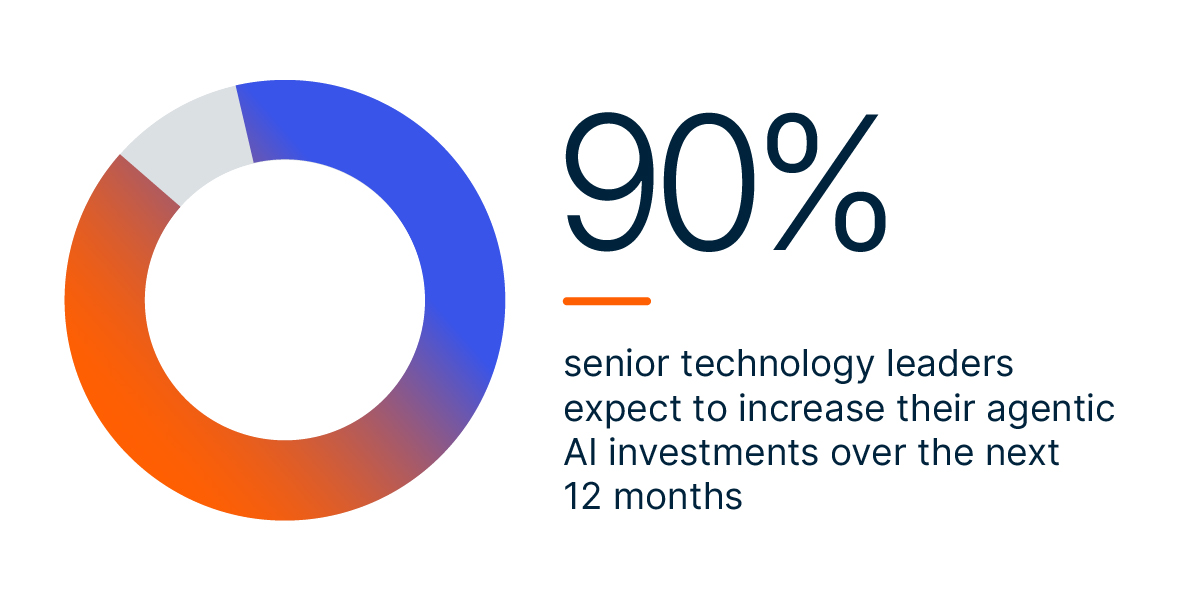
Despite 90% of enterprise tech leaders planning to increase AI investment, 63% report only small or emerging returns not from lack of ambition, but because their data foundations were built for humans, not autonomous agents.
Why agentic AI investments aren’t paying off yet
Enterprise leaders are all in on agentic AI, but most lack the maturity to turn conviction into measurable impact. And many don't even agree on where they stand.
-
93%
believe AI will eventually run core business functions autonomously
-
Only 7%
have reached the Operationalizing stage of agentic AI maturity
-
12% gap
between C-suite and VP views on whether their organization is already operating with agentic AI
Only 7% of enterprises have operationalized agentic AI. View the discussion “How Smart Companies Fail Fast Without Falling Apart” to find out why—and what the top performers are doing differently.
Where enterprises stand on agentic AI maturity
The Agentic AI Maturity Index shows how far organizations have progressed from early experimentation to operationalized agentic AI across enterprise workflows. Most organizations remain in earlier stages of maturity, where pilots are active but production-scale value is still limited.
-
28%
Experimenting
-
40%
Developing
-
25%
Intermediate/
Building -
7%
Operationalizing
The hidden cost of context fragmentation
Agentic AI does not stall because enterprises lack ambition. It stalls because agents cannot act reliably when business context is trapped across systems, teams, and workflows.
- 77% say 20% or less of their enterprise data and knowledge is ready for AI agents to use reliably
- 78% struggle to unify data and knowledge across business functions
- 40% say more than 40% of AI pilots never reach production
- Only 15% get 80% or more of their AI pilots into production
Agentic AI stalls when it can't trust the data it's acting on. Most enterprise data lacks the meaning, lineage, and governance agents need—and the impact shows up in failed pilots.
From personal AI to organizational AI
The AI tools that most enterprises have currently deployed help individuals work faster. Real business returns require organizational AI—systems that automate decisions and execute workflows on behalf of the entire company. The missing link is autonomous knowledge: enterprise data with the context, lineage, and governance agents need to act reliably at scale.
What the research reveals by industry and market
Across six countries and five industries, leaders point to the same core issue: enterprise data lacks the context, connections, and meaning that agents need to be trusted to act autonomously.
-
43%
cite missing metadata, context, and relationships as a top barrier
-
42%
cite data fragmented across systems that can't be connected in real time
-
60%
report decision paralysis on infrastructure decisions
-
51%
cite accuracy and reliability of AI outputs as a significant deployment barrier
The promise of agentic AI is clear. The path to production is not. Download the report to uncover the specific ways enterprise pilots stall and how to move from experimentation to measurable business impact.
Frequently asked questions
| FAQ | Answer |
|---|---|
| Why does agentic AI stall at the enterprise level? | Agentic AI often stalls because enterprise data is fragmented, lacks context, and is not governed in a way that allows agents to act reliably across systems and workflows. |
| Why aren't agentic AI investments producing stronger ROI? | Many organizations are investing in models and software before fixing the data foundation underneath. As a result, AI may improve individual productivity but fail to drive measurable enterprise-wide outcomes. |
| What is the Agentic AI Maturity Index? | The Agentic AI Maturity Index is a framework that shows how organizations progress from early experimentation to operationalized agentic AI across enterprise workflows. |
| What is context fragmentation? | Context fragmentation happens when enterprise data, knowledge, definitions, and governance are spread across systems and teams, making it difficult for AI agents to reason across the full business context. |
| What is autonomous knowledge? | Autonomous knowledge is enterprise data enriched with the context, lineage, business meaning, and governance AI agents need to act reliably and repeatedly at scale. |
| What is the difference between personal AI and organizational AI? | Personal AI helps individuals work faster, such as drafting content or summarizing information. Organizational AI acts on behalf of the business by automating decisions and executing workflows across teams and systems. |
| How can enterprises move agentic AI from experimentation to measurable impact? | Organizations should start by identifying high-value data, making it agent-ready, embedding governance at the source, and building a portable foundation that can support agents across workflows and models. |