Aperçu
ETL — abréviation d’extraction, transformation et charge — est le processus d’intégration des données qui déplace les données de plusieurs systèmes sources vers un entrepôt de données ou un autre système cible, où elles peuvent être nettoyées, standardisées et prêtes à l’analyse. À mesure que les entreprises développent l’analyse cloud, les charges de travail en IA et les rapports en temps réel, un processus ETL bien conçu reste fondamental pour fournir des données précises et gouvernées à chaque étape du pipeline. Lisez la suite pour une définition complète de l’ETL, comment fonctionne le processus ETL étape par étape, comment l’ETL se compare à l’ELT, les cas d’usage courants et les exemples, et comment choisir le bon outil ETL pour votre organisation.
- Ce que c’est : ETL (extraction, transformation, charge) est un processus d’intégration de données qui déplace des données de plusieurs systèmes sources vers un entrepôt de données ou un système cible pour analyse.
- Comment cela fonctionne : Trois étapes : extraire les données brutes des sources, les transformer en un format cohérent, puis les charger dans la destination.
- Quand l’utiliser : Des charges de travail régies, sensibles à la conformité ou sur site où le contrôle de la qualité des données avant le chargement compte plus que la vitesse d’ingestion.
- ETL vs. ELT : ETL se transforme avant le chargement ; L’ELT charge d’abord les données brutes et se transforme à l’intérieur d’un entrepôt cloud. La plupart des entreprises exécutent les deux modèles côte à côte.
Que signifie ETL ?
ETL signifie extraction, transformation et charge. Il s'agit d'un processus d'intégration de données utilisé pour consolider des données provenant de plusieurs sources en une seule destination — généralement un entrepôt de données, un data lake ou une plateforme d'analyse cloud — où elles peuvent être préparées pour des rapports, de l'intelligence métier et des analyses.
Le terme remonte aux années 1970, lorsque les entreprises avaient besoin d’un moyen standardisé de combiner les données de systèmes transactionnels distincts en un dépôt central pour l’analyse. Bien que les outils et les systèmes cibles aient évolué de manière spectaculaire depuis, le concept central — extraire, transformer et charger — reste central dans la manière dont les organisations transmettent les données aujourd’hui.
Qu’est-ce que l’ETL dans le data warehousing ?
ETL, ou extraction, transformation et chargement, désigne le processus dans le data warehousing qui lit ou extrait simultanément des données non structurées du système source — comme un lac de données — convertit (ou transforme) les données dans le format approprié pour les requêtes et l’analyse, puis les charge dans un entrepôt de données sur site, un entrepôt de données cloud, un magasin de données opérationnel, Ou Data Mart. Les systèmes ETL intègrent couramment des données provenant de plusieurs applications ou systèmes qui peuvent être hébergés sur du matériel distinct et gérés par différents groupes ou utilisateurs. L’ETL est couramment utilisé pour assembler un sous-ensemble temporaire de données pour des rapports ad hoc, migrer des données vers de nouvelles bases de données ou convertir des bases de données en nouveaux formats ou types.
L’ETL est important pour l’entreposage de données car il permet la collecte de données brutes à partir de multiples sources de données et la centralisation pour les besoins analytiques. Cela vous permet de faire des requêtes plus rapides car vous posez des questions à partir d'une seule source de données.
Comment fonctionne le processus ETL ?
Les outils ETL consolident automatiquement les données d’une ou plusieurs sources dans un seul conteneur central. Le processus comporte trois étapes :
Extraire : extraire des données des systèmes sources
La phase d’extraction extrait des données brutes de plusieurs systèmes sources, allant des applications d’entreprise et bases de données relationnelles aux fichiers plats, API et appareils connectés à l’Internet des objets (IoT). Les ingénieurs de données configurent l’outil ETL pour se connecter à chaque source, identifier les enregistrements à extraire et les copier dans une zone de préparation où ils peuvent être traités sans affecter les systèmes de production. Parce que les systèmes sources utilisent souvent différents formats, schémas et fréquences de mise à jour, une extraction fiable est fondamentale pour le succès du reste du pipeline.
Transformer : nettoyage et standardisation des données
La phase de transformation convertit les données brutes en un format uniforme adapté à la requête et à l’analyse. Cela peut inclure le filtrage des enregistrements incomplets ou doublonnés, l’application de règles métier, la standardisation des formats (tels que les dates, les devises ou les unités de mesure), la reliaison des données provenant de plusieurs sources, et l’agrégation des enregistrements pour les rapports. Les transformations convertissent souvent les données en tables compatibles avec le langage de requête structurée (SQL), bien que les outils ETL modernes gèrent aussi des formats semi-structurés comme le JSON. Une étape de transformation bien conçue garantit que les consommateurs en aval travaillent à partir de données cohérentes et fiables.
Charge : Transfert des données vers le système cible
La phase de chargement écrit les données transformées dans le système cible — généralement un entrepôt de données, un datalake, un data mart ou un stockage de données opérationnel. Le chargement peut se faire en lots programmés (par exemple, un travail nocturne qui met à jour l'entrepôt avec les données de ventes de la veille) ou en quasi-temps réel via des pipelines de streaming. Le système cible devient alors la source unique de vérité pour l’analytique, les tableaux de bord, les modèles d’apprentissage automatique et toute autre application en aval qui dépend des données d’entreprise consolidées.
Types d’outils ETL
Les outils ETL et les logiciels ETL existent sous plusieurs formes, chacune adaptée à différentes architectures et exigences opérationnelles. Le bon choix dépend de l’emplacement de vos données, de la rapidité avec laquelle vous avez besoin de les utiliser pour analyse, et de la structure et de la prévisibilité de vos charges de travail ou variables et en temps réel.
Outils ETL sur site
Les outils sur site permettent une meilleure sécurité, car toutes les données sont stockées sur site. Ils offrent un contrôle de conformité plus strict car les données ne quittent jamais votre environnement, ce qui en fait un choix courant pour les secteurs soumis à des exigences réglementaires strictes comme les services financiers, la santé et le gouvernement.
Outils ETL basés sur le cloud
Les logiciels cloud sont spécifiquement conçus pour les processus ETL qui servent des entrepôts de données et des applications basés sur le cloud. Ces outils scalent le calcul et le stockage à la demande, s’intègrent nativement aux sources SaaS modernes et réduisent la surcharge d’infrastructure — ce qui les rend bien adaptés aux organisations faisant tourner des analyses sur des plateformes telles que Snowflake, Amazon Redshift, Google BigQuery ou Microsoft Azure.
Outils ETL batch
Le logiciel batch réalise le processus ETL par lots, ce qui est idéal pour l’analyse régulière et le reporting de données structurées — comme les informations sur la paie. Les tâches batch fonctionnent généralement selon un calendrier comme une nuit ou une heure à l'heure, traitant les données accumulées en grandes quantités, et elles conviennent parfaitement à des charges de travail prévisibles comme les rapports financiers mensuels ou les totaux de ventes de fin de journée.
Outils ETL en temps réel et en streaming
Les outils ETL en temps réel minimisent le temps nécessaire pour collecter et analyser les informations dans le pipeline de données. Ils traitent les données en continu au fur et à mesure que les événements surviennent, ce qui les rend essentiels pour des cas d’utilisation tels que la détection de fraude, la surveillance de l’IoT, les moteurs de recommandation, et toute application dépendant d’informations à la seconde près.
Avantages de l’ETL
L’ETL offre plusieurs avantages importants pour les organisations qui doivent consolider et analyser des données provenant de l’ensemble de l’entreprise.
Vue unifiée des données d’entreprise
En consolidant les données de plusieurs systèmes sources en une seule cible, l’ETL offre aux analystes, cadres et utilisateurs métier une vision unifiée des opérations, des clients et de la performance. Au lieu de puiser des rapports dans des outils cloisonnés avec des définitions incohérentes, les équipes interrogent une source unique de vérité réconciliée — ce qui réduit le risque que des chiffres contradictoires apparaissent dans différentes parties de l’entreprise.
Amélioration de la qualité et de la cohérence des données
Grâce à une utilisation appropriée de l'ETL, les données existent sous un format uniforme qui peut être plus facile à suivre à travers les pipelines de données et l'architecture globale d'une entreprise. La phase de transformation applique des règles de nettoyage, de validation et de normalisation qui détectent les erreurs, suppriment les doublons et imposent des formats cohérents avant que les données n’atteignent les systèmes en aval — ce qui signifie que les analystes et les applications travaillent à partir de dossiers fiables.
Soutient l’intelligence économique et l’analyse
Business intelligence est un terme large qui englobe l’exploration de données, l’analyse de processus, le benchmarking de performance et l’analyse descriptive. Sans ETL, les entreprises auraient beaucoup de mal à compiler et analyser les données pour la gestion des données. L’ETL permet aux entreprises de formuler des requêtes complexes et d’obtenir des réponses rapides qui les aident à prendre de meilleures décisions.
Accélère la migration et la modernisation du cloud
Le processus ETL vous permet de puiser des données de nombreuses sources disparates et de les transférer vers un entrepôt de données centralisé ou une plateforme d’analyse. Sans outils ETL, cela peut être exceptionnellement difficile et chronophage, surtout si vous travaillez avec de nombreuses sources et types de données divers.
Réduit l’effort manuel grâce à l’automatisation
Les outils d’automatisation permettent d’effectuer des ETL sans surveillance constante. C’est particulièrement vrai pour les entreprises à grande échelle qui traitent de grandes quantités de données chaque jour. Les outils ETL automatisés protègent également les équipes de données contre les risques liés à l’erreur humaine.
Défis de l’ETL
Malgré sa valeur, l’ETL présente aussi quelques défis importants :
- Manque de scalabilité. L'ETL repose sur des sources de données prévisibles qui ne changent pas beaucoup pour fonctionner. Si vous changez d'environnement informatique, vous devrez ajuster vos processus de test ETL pour qu'ils suivent.
- La transformation conduisant à des données erronées ou inexactes si elle n’est pas testée pour la qualité et explorée avant le début du processus. Les outils ETL sont complexes et nécessitent une grande expertise pour fonctionner correctement. Sans tests, nettoyages et exploration appropriés, des erreurs peuvent se retrouver dans les données.
- Idées contradictoires sur l’ETL. L’analyse de données et l’ingénierie des données sont toutes deux essentielles pour toutes les équipes de données, mais elles ont des objectifs distincts. Les data scientists réalisent des analyses de données à l’aide d’outils tels que l’apprentissage automatique (ML) dans le domaine de la science des données. Les ingénieurs de données travaillent avec des données brutes pour les transformer en informations utiles à la prise de décision.
ETL vs. ELT : Quelle est la différence ?
Extract, load, and transform (ELT) est une variante du pipeline ETL, souvent utilisée dans des environnements cloud. Au lieu de transformer les données avant le chargement, l’ELT ingère et stocke les données brutes dans un entrepôt de données ou un datalake, où elles peuvent être transformées plus tard pour l’analyse.
Parce que la transformation se produit après le chargement, l’ELT peut améliorer la vitesse et la flexibilité, en particulier dans les architectures cloud-native qui supportent le traitement de données à grande échelle et le calcul à la demande.
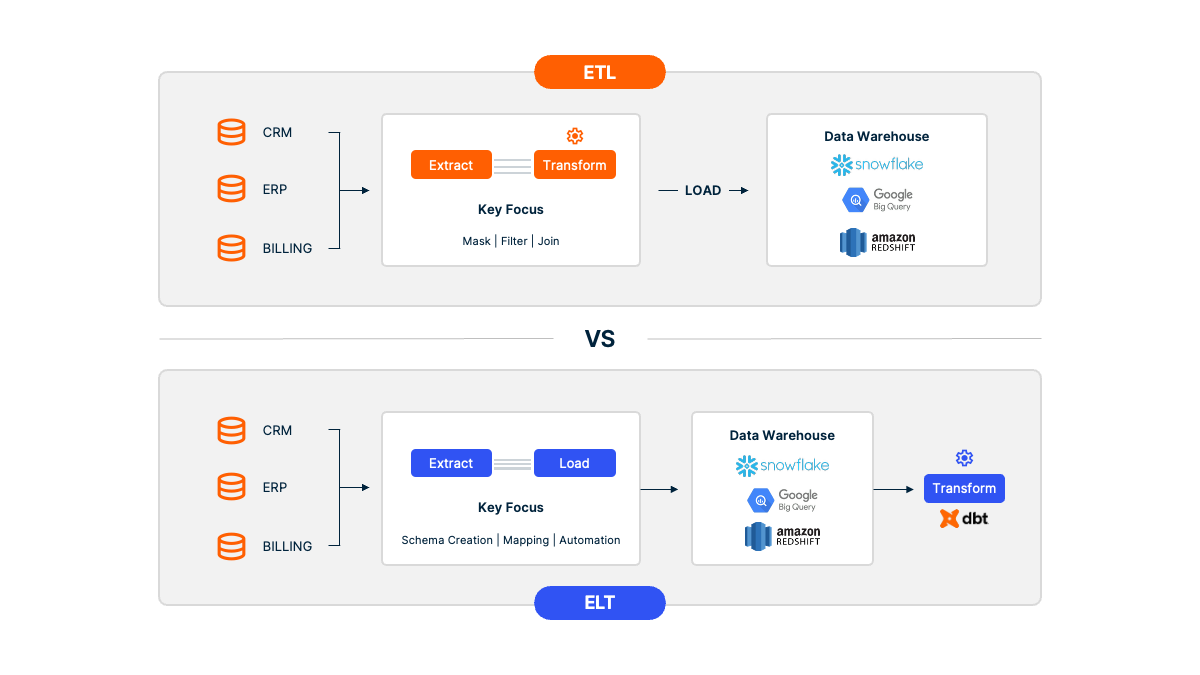
Source : https://www.striim.com/blog/etl-vs-elt-differences/
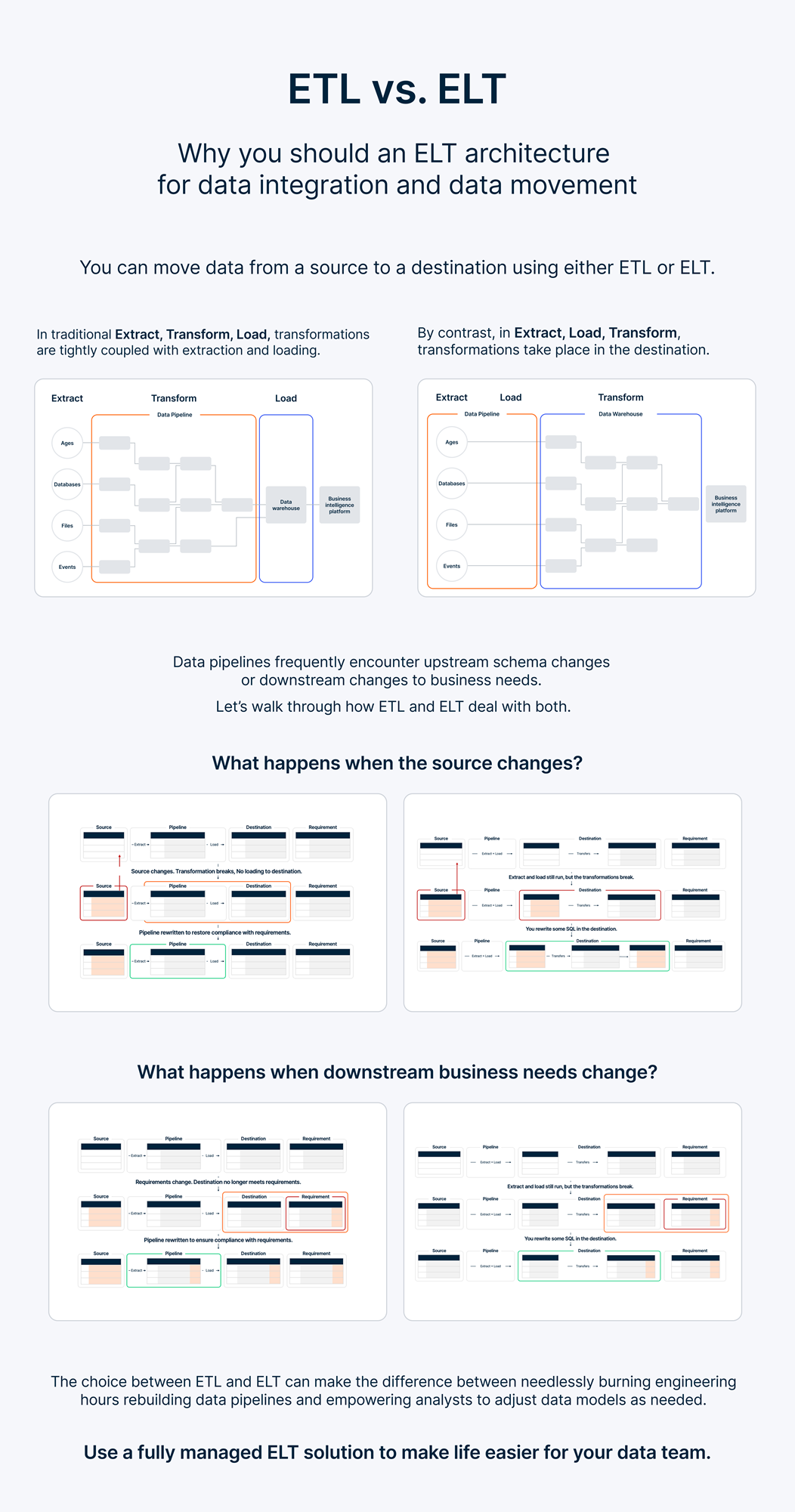
Bien que l’ETL et l’ELT suivent des étapes similaires, ils diffèrent dans la manière et le moment où les données sont transformées, où le calcul a lieu, et aux charges de travail pour lesquelles chacun est le mieux adapté. Le tableau ci-dessous résume les principales différences entre ETL et ELT en termes de traitement, d’architecture, de coût, de gouvernance et de cas d’usage courants.
Source : https://www.linkedin.com/posts/salim-raj-kapoor-184b8b255_100daysofdataengineering-dataengineering-activity-7426818388519370752-FPMj/
En général, l’ETL est préféré pour les environnements structurés et contrôlés, tandis que l’ELT est mieux adapté à l’analyse évolutive basée sur le cloud.
Quand utiliser l’ETL
Choisissez ETL lorsque vos charges de travail nécessitent une gouvernance stricte, des performances prévisibles et des règles métier bien définies appliquées avant que les données n’atteignent l’entrepôt. L’ETL est un excellent choix pour les secteurs réglementés tels que les services financiers, la santé et le gouvernement, où les exigences de conformité exigent que les données sensibles soient validées et standardisées dans un environnement de staging contrôlé avant le chargement. Il convient également aux organisations qui gèrent principalement des entrepôts de données sur site, à celles disposant de besoins de reporting stables, ou aux équipes privilégiant l’isolement de la charge de travail et la prévisibilité des coûts plutôt que la vitesse brute d’ingestion.
Quand utiliser l’ELT
Choisissez l’ELT lorsque vos volumes de données sont importants, vos sources variées, et que votre système cible est un entrepôt de données cloud moderne ou un data lake avec calcul élastique. L’ELT s’adapte aux charges de travail là où la flexibilité compte — par exemple, les pipelines de data science et d’apprentissage automatique qui bénéficient de l’accessibilité des données brutes pour le retraitement, ou les équipes d’analytique souhaitant itérer les transformations SQL à l’intérieur de l’entrepôt. L’ELT convient également bien aux organisations qui standardisent les stacks cloud-natives.
Cas d’usage courants et exemples d’ETL
L’ETL prend en charge un large éventail de charges de travail de données d’entreprise. Voici quatre des cas d’usage les plus courants sur lesquels les organisations comptent aujourd’hui sur l’ETL.
Intégration et consolidation d’entrepôts de données
Le cas d’usage le plus établi de l’ETL est la construction et la maintenance d’un entrepôt de données d’entreprise. Les organisations extraient des données des systèmes CRM, ERP, finance, marketing et opérationnels, les transforment en formats cohérents, puis les intègrent dans un entrepôt central où elles peuvent être analysées collectivement. Cette vision consolidée est la base des tableaux de bord exécutifs, de la consolidation financière et du reporting interfonctionnel qui seraient impossibles à produire à partir de systèmes sources cloisonnés.
Migration cloud et architectures hybrides
L’ETL joue un rôle crucial dans le transfert des données des systèmes locaux hérités vers les plateformes cloud modernes. Lors d’une migration cloud, les pipelines ETL extraient des données de bases de données vieillissantes, les transforment pour s’adapter à de nouveaux schémas cibles, puis les chargent dans des entrepôts cloud ou des datalakes — souvent en vagues phasées permettant aux systèmes hérités et cloud de fonctionner en parallèle. L’ETL est également essentiel dans les architectures hybrides en cours où certaines données restent sur site pour des raisons de conformité ou de latence tandis que d’autres charges de travail s’exécutent dans le cloud.
Intelligence économique et reporting
Les pipelines ETL alimentent les données propres et standardisées qui alimentent les outils BI, les plateformes d’analyse en libre-service et le reporting exécutif. Les équipes financières utilisent des données préparées par ETL pour la clôture mensuelle et la budgétisation ; les équipes commerciales et marketing l’utilisent pour l’analyse du pipeline et l’attribution des campagnes ; les équipes opérationnelles l’utilisent pour les tableaux de bord des KPI. Sans ETL, chaque équipe devrait suivre sa propre logique d’extraction et de nettoyage, ce qui entraînerait des chiffres incohérents, des efforts gaspillés et des versions concurrentes de la vérité.
Pipelines de données d’apprentissage automatique et d’IA
L’ETL moderne prend de plus en plus en charge l’apprentissage automatique et les charges de travail en IA. Les modèles ML reposent sur des données d’entraînement cohérentes et bien gérées, et les pipelines ETL sont la façon dont ces données sont préparées — extraites des systèmes opérationnels, nettoyées et standardisées, puis chargées dans les magasins de fonctionnalités ou les environnements d’entraînement des modèles. À mesure que les entreprises développent des cas d’utilisation en IA générative et analytique prédictive, un ETL fiable garantit que les modèles sont entraînés sur des données fiables suivies par lignée, plutôt que sur des extractions ad hoc.
Comment choisir le bon outil ETL
Lors du choix des outils ETL, plusieurs facteurs sont à prendre en compte. Votre outil ETL devrait avoir :
- Fonctionnalités de surveillance complètes. Une illustration détaillée des progrès lors de l’exécution des tâches ETL est essentielle pour une transparence maximale.
- Gestion efficace des erreurs. Si quelque chose tourne mal, l’outil ETL devrait pouvoir expliquer pourquoi. De plus, il devrait avoir des mesures préventives contre la perte de données.
- Évolutivité. Si vous attendez à ce que votre entreprise croisse, vos outils devraient pouvoir évoluer avec vous. Un outil ETL qui ne peut pas gérer une quantité croissante de données ne sera pas utile longtemps.
- Une interface facile à utiliser. L’outil ETL le plus avancé du marché est d’une aide limitée si son interface n’a aucun sens. Votre outil d’intégration de données doit être sans bugs, fiable et facile à configurer.
- Compatibilité avec diverses sources de données. Si vous devez collecter des données à partir d’un large éventail de conteneurs, qu’il s’agisse d’un entrepôt de données ou d’une base de données, votre outil devrait pouvoir fonctionner avec tous sans accroc. Il devrait également pouvoir fonctionner sans interruption avec une variété de services cloud.
L'ETL a des usages spécifiques, mais ce n'est généralement pas une approche adaptée au big data en soi. Au contraire, cela devrait faire partie d’une stratégie plus large tenant compte des tendances actuelles des données et des processus en constante évolution.
Questions fréquemment posées
Vous avez encore des questions sur l’ETL ? Voici des réponses à certaines des questions les plus courantes.
L’ETL est-il toujours pertinent dans les architectures de données modernes ?
L’ETL est-il toujours pertinent dans les architectures de données modernes ?
Oui — l’ETL reste au cœur du travail moderne sur les données, bien que son rôle ait évolué. Bien que l’ELT soit devenu le modèle par défaut pour les charges de travail d’analytique et de data science natives du cloud, l’ETL reste le bon choix pour les charges de travail réglementées, gouvernées et sur site où un contrôle strict de la qualité des données avant le chargement est nécessaire. De nombreuses entreprises exécutent les deux modèles côte à côte, utilisant l’ETL pour les pipelines financiers sensibles ou critiques pour la conformité et l’ELT pour des analyses flexibles à haut volume et des cas d’utilisation de l’IA.
Qu’est-ce qu’un pipeline ETL ?
Qu’est-ce qu’un pipeline ETL ?
Un pipeline ETL est l’ensemble des processus et outils connectés qui transplacent les données des systèmes sources à travers les étapes d’extraction, de transformation et de chargement vers un système cible. Un pipeline ETL unique peut gérer un flux de données spécifique — par exemple, extraire des registres de ventes quotidiens d’un système de point de vente, les nettoyer et les charger dans un entrepôt de reporting commercial — tandis qu’une grande entreprise gère généralement des dizaines voire des centaines de pipelines à travers différents domaines de données.
En quoi l’ETL diffère-t-il de l’intégration des données ?
En quoi l’ETL diffère-t-il de l’intégration des données ?
L’intégration des données est la catégorie plus large — tout processus qui combine des données provenant de plusieurs sources en une vue unifiée. L’ETL est une approche spécifique de l’intégration des données, caractérisée par la séquence d’extraction, de transformation et de charge en trois étapes. D’autres approches d’intégration des données incluent l’ELT, la virtualisation des données, la capture de données de modification (CDC) et la réplication des données. L’ETL est le plus établi d’entre eux et est particulièrement adapté aux charges d’analyse orientées batch où les données transformées et sélectionnées sont la cible.
Que fait un développeur ETL ?
Que fait un développeur ETL ?
Un développeur ETL conçoit, construit et maintient les pipelines qui transmettent les données des systèmes sources vers les systèmes cibles. Le poste consiste à écrire de la logique d’extraction, à définir des règles de transformation, à optimiser les performances, à surveiller l’état de la conduite et à dépanner les défaillances. Les développeurs ETL travaillent généralement avec des outils comme Informatica, Talend, SSIS, dbt ou des services cloud-natives, et collaborent étroitement avec les ingénieurs de données, les analystes de données et les parties prenantes métier pour garantir que les pipelines livrent des données précises dans les délais.