Aperçu
L'IA privée est la pratique consistant à déployer des modèles d'intelligence artificielle et les données qui les entraînent dans l'environnement contrôlé par une organisation — sur site, dans un cloud privé ou dans une enclave souveraine — afin que les données sensibles, les poids propriétaires des modèles et les charges de travail réglementées ne quittent jamais le périmètre de l'entreprise.
Contrairement aux services d’IA publics qui envoient des données vers des modèles partagés gérés par les fournisseurs, l’IA privée conserve les données, l’inférence et la gouvernance sous un seul propriétaire responsable. Pour les industries réglementées, l’IA privée est de plus en plus le seul modèle architectural qui satisfait à la fois l’ambition de l’IA et la réalité de la conformité .
Définition de l’IA privée
L’IA privée désigne le déploiement de systèmes d’intelligence artificielle dans un environnement contrôlé directement par une organisation, plutôt que sur une infrastructure exploitée par un tiers. En termes pratiques, cela signifie que les données utilisées pour entraîner ou ancrer un modèle, les poids du modèle eux-mêmes, et le calcul qui exécute l’inférence restent tous dans des limites organisationnelles définies — qu’il s’agisse d’un centre de données sur site, d’un cloud privé dédié ou d’une enclave souveraine opérée sous des exigences strictes de résidence.
Il est important de distinguer l'IA privée du concept apparenté mais distinct de la vie privée de l'IA. La confidentialité de l’IA est une préoccupation destinée aux utilisateurs : elle répond à ce qui arrive aux requêtes, aux demandes et aux informations personnelles que les individus soumettent aux applications d’IA comme les chatbots publics. L'IA privée est une préoccupation d'architecture organisationnelle : elle traite de ce qui arrive aux données d'une entreprise, à ses connaissances propriétaires et à la propriété intellectuelle des modèles lorsque l'IA est déployée à grande échelle. Les deux se chevauchent, mais ne sont pas interchangeables — et la distinction est importante lorsque les dirigeants d’entreprise évaluent la place de l’IA dans leur modèle de gouvernance.
Les schémas de déploiement qui qualifient d’IA privée se situent sur un spectre. À une extrémité, l’IA privée entièrement sur site offre la forme de contrôle la plus puissante : chaque octet de données et chaque poids de modèle reposent sur l’infrastructure que l’organisation possède et exploite. Une configuration cloud privée, dans laquelle une location dédiée est assurée par un fournisseur de confiance, réduit les dépenses d’investissement tout en préservant la plupart des avantages de souveraineté. À l’extrémité opposée, l’informatique confidentielle dans un cloud public utilise un chiffrement matériel pour isoler les charges de travail de l’opérateur cloud lui-même — une avancée significative, mais qui nécessite néanmoins une infrastructure de confiance en dehors du périmètre de l’entreprise.
Comment fonctionne l’IA privée
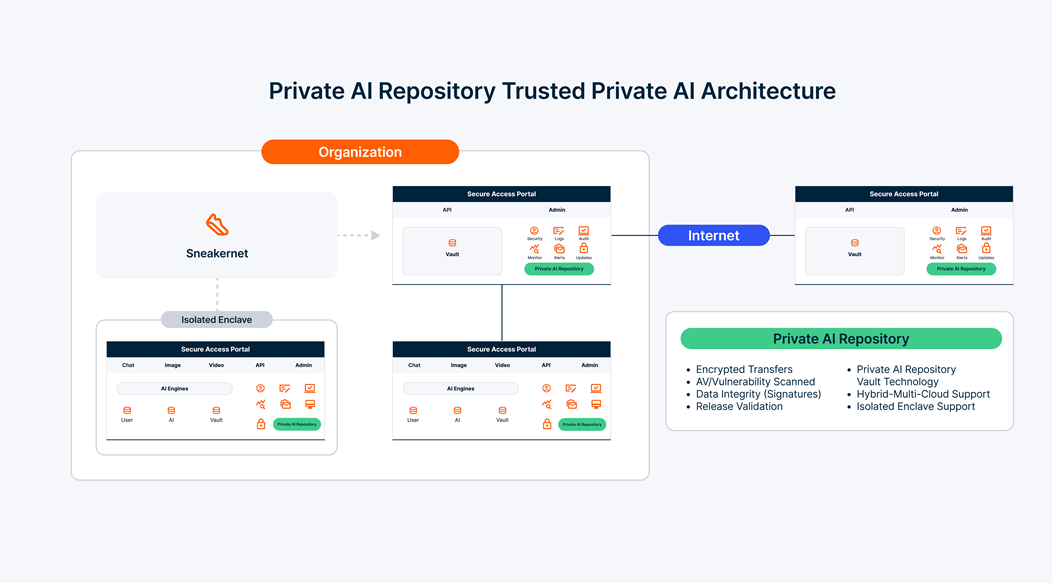
Un déploiement privé d’IA se comprend mieux comme une pile de quatre couches fonctionnelles, chacune ayant pour but précis de maintenir l’alignement des données, des modèles et de la gouvernance.
La couche de données
La base de tout système d’IA privé réside dans ses données. Dans une architecture d’IA privée, les données d’entraînement, les archives de documents à génération augmentée par récupération (RAG) et les embeddings vectoriels résident tous sur le stockage contrôlé par l’organisation. Rien n'est copié vers un service externe pour traitement, et rien n'est exposé au pipeline de formation d'un tiers. Pour les entreprises qui ont passé des décennies à construire des systèmes d’enregistrement fiables — données clients, historique transactionnel, dossiers cliniques — l’IA privée garantit que les charges de travail IA du futur s’appuient sur cette même base gouvernée.
La couche modèle
La couche modèle contient les algorithmes qui transforment les données en prédictions, classifications ou contenu généré. Dans un déploiement privé d’IA, cela inclut les modèles de base (souvent des modèles de fondation à poids ouvert déployés dans l’environnement d’entreprise), les modèles affinés entraînés sur des données propriétaires, et les embeddings qui supportent la récupération. Les poids des modèles sont, à bien des égards, l'atout le plus sensible qu'un système d'IA privé protège — un modèle affiné a absorbé les connaissances accumulées de l'organisation et, une fois entraîné, représente la propriété intellectuelle institutionnelle qu'on ne peut pas laisser fuir.
La couche d’inférence
L’inférence est lorsque l’inférence devient une réponse. Dans un système d’IA privé, la couche d’inférence fonctionne sur un calcul contrôlé par l’entreprise — souvent accéléré par GPU — et renvoie les réponses sans envoyer l’invite ni son contexte à une API externe. Cette architecture présente deux propriétés importantes : la latence est prévisible, car le trafic reste sur le réseau d’entreprise ; et le contenu sensible des prompts, comme les notes cliniques ou les dossiers clients, ne quitte jamais le périmètre.
La couche de gouvernance
La couche de gouvernance est ce qui rend l'IA privée défendable auprès des auditeurs, des régulateurs et des équipes de gestion des risques et de conformité de l'entreprise. Il applique les contrôles d’accès, enregistre chaque invite et chaque réponse, maintient la lignée des modèles et soutient les traces d’audit qui prouvent — après coup — qui a utilisé quel modèle, sur quelles données, à chaque fin. La gouvernance n’est pas une superposition à l’IA privée ; C’est une propriété de conception de ce projet.
 Source : https://www.redrake.com/portfolio-items/trusted-private-artificial-intelligence
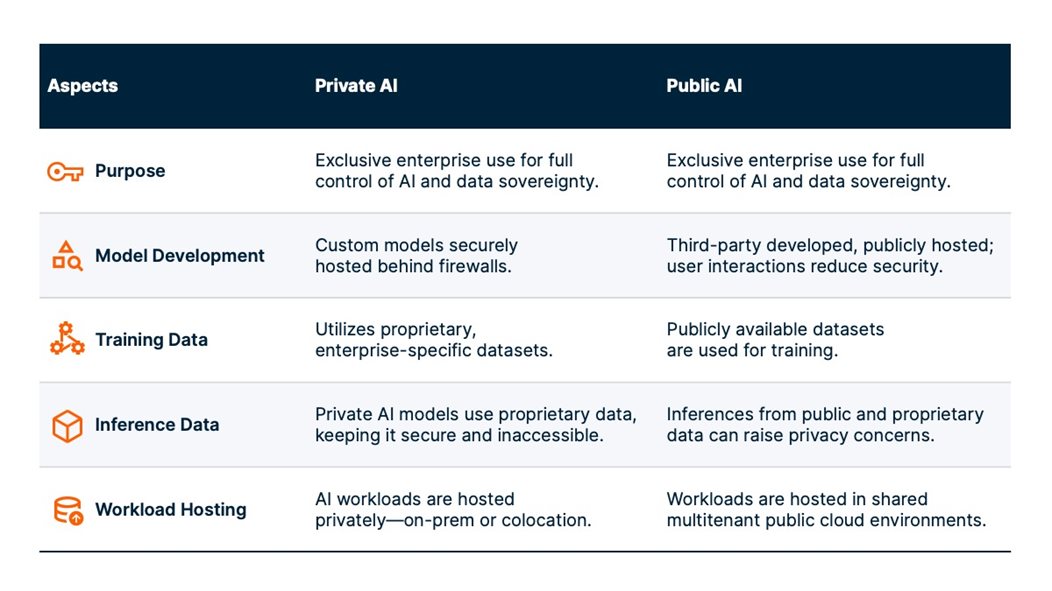
IA privée vs. IA publique
Le choix entre l’IA privée et l’IA publique dépend moins de ce qui est « meilleur » que des compromis architecturaux qu’une entreprise est prête à faire. Les services publics d’IA offrent un accès rapide à des capacités et à une échelle de pointe qu’aucune organisation ne pourrait reproduire seule. L’IA privée offre le contrôle, la souveraineté des données et la capacité de garder les connaissances propriétaires véritablement propriétaires.
L’IA publique est conçue pour la rapidité et la largeur, tandis que l’IA privée est conçue pour le contrôle et la défendabilité. Aucune des deux options n’est universellement la bonne réponse. Les charges de travail à faible sensibilité bénéficient d’itérations rapides fonctionnent souvent bien sur les services publics d’IA. Les charges de travail réglementées, celles qui reposent sur des connaissances propriétaires et les charges avec des exigences strictes de résidence des données nécessitent presque toujours le modèle d’IA privée — et de plus en plus, les entreprises adoptent des approches hybrides qui orientent des charges de travail spécifiques vers le modèle qui convient.
Avantages de l’IA privée
Pour les entreprises opérant dans des environnements réglementés ou sensibles à la propriété intellectuelle, les avantages de l’IA privée sont structurels plutôt que progressifs.
- La souveraineté des données. Les données ne franchissent jamais le périmètre de l’entreprise, ce qui signifie que les exigences de résidence, les obligations contractuelles de confidentialité et les réglementations sectorielles spécifiques comme HIPAA, GDPR, PCI DSS et FedRAMP sont satisfaies par l’architecture elle-même plutôt que par des attestations fournissantes.
- Propriété de modèle. Les poids de modèles affinés représentent les connaissances institutionnelles accumulées — les normes de conformité d'une banque, les schémas de raisonnement clinique d'un hôpital, les heuristiques de détection de défauts d'un fabricant. Dans l'IA privée, ces poids restent la propriété intellectuelle de l'entreprise, et non un actif partagé au sein de la chaîne de formation d'un tiers.
- Coût et latence prévisibles. Le prix par jeton évolue de façon inconfortable en volume d’entreprise. L'IA privée déplace le profil de coûts vers les dépenses d'investissement plus des dépenses d'exploitation prévisibles, et la latence d'inférence devient une fonction du réseau d'entreprise plutôt que de l'API d'un fournisseur.
- Des audits défendables. Chaque prompt, recherche et réponse est enregistrée sur l’infrastructure contrôlée par l’entreprise, produisant le type de dossier complet et horodaté que les auditeurs et régulateurs s’attendent à voir.
- Alignement avec la gouvernance existante. Pour les organisations qui gèrent déjà des programmes de gouvernance des données matures, l’IA privée étend les contrôles existants — gestion des accès, lignée, audit, conservation — pour couvrir les charges de travail de l’IA, plutôt que d’exiger un modèle de gouvernance entièrement nouveau pour accommoder des fournisseurs externes.
Techniques de préservation de la vie privée dans l’IA privée
L’IA privée n’est pas une technique unique — c’est un empilement d’entre elles. Plusieurs approches distinctes, souvent utilisées ensemble, permettent d’exécuter l’IA sur des données sensibles sans compromettre l’intégrité de ces données ni des modèles qui en tirent des enseignements.
Apprentissage fédéré
L’apprentissage fédéré permet d’entraîner un modèle à travers plusieurs organisations ou silos de données sans déplacer les données sous-jacentes. Chaque participant entraîne localement le modèle sur ses propres données ; seules les mises à jour du modèle — et non les données elles-mêmes — sont partagées et agrégées. Ce schéma a une importance particulière dans les consortiums de santé et la collaboration financière transfrontalière, où la valeur d’un modèle partagé est élevée mais où les données ne peuvent pas être légalement mises en commun.
Confidentialité différentielle
La confidentialité différentielle offre une garantie mathématique que les enregistrements individuels ne peuvent pas être rétro-ingénierés à partir des sorties d'un modèle. En introduisant un bruit soigneusement calibré dans l'entraînement ou l'inférence, les organisations peuvent utiliser statistiquement des données sensibles tout en s'assurant qu'aucune contribution d'un enregistrement unique ne puisse être isolée. La confidentialité différentielle est de plus en plus une attente de base pour les systèmes d’IA entraînés sur des données personnelles ou réglementées.
Informatique confidentielle
L’informatique confidentielle utilise des enclaves sécurisées matérielles pour isoler les charges de travail de l’infrastructure qui les fait fonctionner. À l’intérieur de l’enclave, les données et le code restent chiffrés même pendant le traitement, ce qui signifie que ni l’opérateur cloud ni un système d’exploitation hôte compromis ne peuvent lire avec quoi le modèle fonctionne. Pour les entreprises faisant tourner l’IA dans un cloud privé ou un cloud public confidentiel, c’est souvent le mécanisme qui élève la confiance en l’infrastructure à un niveau acceptable.
Données synthétiques
Les données synthétiques sont des données générées artificiellement qui préservent les propriétés statistiques et relationnelles des données réelles sans contenir d’enregistrements réels. En IA privée, les données synthétiques peuvent étendre les ensembles d’entraînement, soutenir l’expérimentation dans des environnements moins contrôlés, ou permettre le partage de données entre équipes autrement bloquées par des règles de confidentialité. L’utilité des données synthétiques dépend fortement de la qualité du processus de génération — des données synthétiques mal générées peuvent introduire un biais ou manquer le comportement statistique de queue qui compte le plus dans la production.
Sur site vs cloud privé : Quelle forme d’IA privée avez-vous besoin ?
« L'IA privée » n'est pas un schéma de déploiement unique — c'est un spectre, et le bon point sur ce spectre dépend du profil de risque de l'organisation, de sa posture de capital et des obligations réglementaires.
- Le déploiement sur site place chaque couche du système d’IA sur l’infrastructure que l’organisation possède et exploite. Elle offre la forme la plus forte de souveraineté : aucun tiers n’a accès physique ou logique au matériel, aux données ou aux modèles. Le compromis est les dépenses d’investissement et la responsabilité opérationnelle — l’organisation doit investir dans l’infrastructure elle-même et la maintenir.
- Le déploiement du cloud privé place le système d’IA sur une infrastructure dédiée à locataire unique fournie par un fournisseur de confiance. La souveraineté est préservée pour la plupart des usages pratiques, et le profil du capital se déplace vers les dépenses d’exploitation. Le compromis est qu’une part de la confiance est déléguée au fournisseur, dont les pratiques opérationnelles relèvent désormais du modèle de menace.
- L’informatique confidentielle dans le cloud public utilise un chiffrement matériel pour isoler les charges de travail de l’opérateur cloud lui-même — une avancée significative qui permet aux entreprises d’exécuter des charges de travail IA sensibles dans une infrastructure partagée avec de fortes garanties cryptographiques. Cela réduit la confiance requise dans l’opérateur cloud, mais ne l’élimine pas ; L’entreprise fonctionne toujours sur une infrastructure qu’elle ne possède pas.
Chacun de ces motifs est considéré comme une IA privée selon une définition raisonnable. Pour les entreprises dont les modèles de menaces, les obligations réglementaires ou les préoccupations liées à la propriété intellectuelle nécessitent la forme de contrôle la plus forte possible, le déploiement sur site reste l’ancre. Pour les entreprises avec des contraintes différentes, un système cloud privé ou informatique confidentiel peut offrir le bon équilibre entre contrôle et économie.
Industries qui bénéficient le plus de l’IA privée
L’adoption de l’IA privée est la plus forte dans les secteurs où les données sensibles, les obligations réglementaires et les connaissances propriétaires se croisent. Dans ces secteurs, l’IA publique n’est souvent pas une option viable — ni par la politique, ni par la réglementation, ni par les réalités commerciales de la protection de la propriété intellectuelle.
Services financiers
Les institutions financières gèrent les dossiers clients, les données transactionnelles et les modèles analytiques propriétaires qui ne peuvent pas être exposés à des systèmes d’IA externes. L’IA privée permet aux banques d’entraîner des modèles sur la documentation « connaissance-vous-client, de construire des systèmes de détection de fraude sur des historiques complets de transactions et de déployer des assistants en IA générative » pour les responsables de la conformité — le tout sans envoyer de données clients ou de poids de modèles à l’extérieur de l’institution. L'interprétation propriétaire de la conformité d'une banque, accumulée au fil des décennies, est précisément le type d'actif que l'IA privée doit protéger.
 Source : https://www.techaheadcorp.com/blog/private-ai-for-enterprises-a-game-changer-to-safeguard-the-business
Santé et sciences de la vie
Les organisations de santé opèrent sous certains des régimes de confidentialité des données les plus stricts qui soient, et la sanction en cas de violation d’informations de santé protégées est sévère. L'IA privée permet aux hôpitaux de déployer le résumé des notes cliniques, l'analyse d'images médicales et des outils de support en contact direct avec les patients, sans que la PHI ne quitte l'environnement régi par l'hôpital. Les organisations des sciences de la vie appliquant l’IA à la découverte de médicaments s’appuient également sur l’IA privée pour protéger les données moléculaires propriétaires et les actifs de recherche représentant des années d’investissement.
Fabrication
Les fabricants appliquent de plus en plus l’IA à l’inspection qualité, à la maintenance prédictive et à l’optimisation de la chaîne d’approvisionnement. Le modèle de détection des défauts du fabricant, entraîné sur des images de production produite, intègre une compréhension détaillée de ses modes de défaillance — des informations que les concurrents seraient prêts à payer pour obtenir. L'IA privée conserve ce modèle, ainsi que les données d'entraînement qui le sous-tendent, dans l'environnement propre du fabricant.
Comment Teradata supporte l’IA privée
L'approche de Teradata en matière d'IA privée repose sur le même principe qui a façonné la plateforme de données de l'entreprise pendant des décennies : les charges de travail à l'échelle des entreprises méritent un contrôle de niveau entreprise. L’IA privée étend ce principe à l’ensemble du cycle de vie du modèle d’IA — ajustement fin sécurisé des données propriétaires, génération augmentée par récupération sur des archives de documents sensibles, déploiement réglementé du modèle, et audit et lignée complets pour chaque prompt et réponse.
Pour les entreprises ayant déjà investi dans des systèmes d’enregistrement fiables, l’avantage réside dans la continuité. Les modèles d’IA entraînés parallèlement aux données résidentes de l’entrepôt qui régissent le reste de l’entreprise héritent des mêmes contrôles d’accès, de la même lignée et de la même posture de gouvernance. Il n’est pas nécessaire de construire un modèle de gouvernance parallèle pour les charges de travail de l’IA — elles se situent à l’intérieur de celui déjà en place.
Des fonctionnalités telles que l'Enterprise Vector Store de Teradata, les fonctions d'IA/ML intégrées dans la base de données, et le support intégré des modèles de fondation open weight via Bring Your Own LLM permettent aux équipes de données et d'analyse de construire, d'ajuster et de déployer de l'IA sans que les données ou les modèles ne quittent jamais l'environnement en lequel elles ont confiance.
Pour en savoir plus sur la manière dont Teradata soutient l’IA privée à l’échelle de l’entreprise, contactez notre équipe.
Questions fréquemment posées
Vous avez encore des questions sur l’IA privée ? Voici des réponses à certaines des questions les plus courantes.
Existe-t-il une IA privée ?
Existe-t-il une IA privée ?
Oui. Un système d'IA privé est un système où le modèle, les données qu'il utilise et le calcul qui exécute l'inférence restent tous à l'intérieur de l'environnement contrôlé par une organisation. Les options vont des modèles de fondation open-weight auto-hébergés fonctionnant sur des GPU d’entreprise, aux déploiements dédiés dans le cloud privé, en passant par des arrangements de calcul confidentiel dans l’infrastructure du cloud public.
Comment fonctionne l’IA privée ?
Comment fonctionne l’IA privée ?
L’IA privée fonctionne en maintenant quatre couches — données, modèles, inférence et gouvernance — à l’intérieur de l’infrastructure contrôlée par l’organisation. Les données d’entraînement et les magasins vectoriels sont situés sur le stockage d’entreprise ; Les poids des modèles sont hébergés sur Enterprise Compute ; l’inférence s’exécute sans contacter d’API externes ; et chaque action est enregistrée pour l’audit et la lignée. Le résultat est un système d’IA où aucune requête, aucun enregistrement, aucun poids finement réglé ne quitte jamais le périmètre.
Combien coûte l’IA privée ?
Combien coûte l’IA privée ?
L’IA privée déplace le profil de coûts de la dépense d’exploitation par jeton vers une combinaison d’investissements en capital et de coûts d’exploitation prévisibles. À faible volume, les API publiques d’IA sont généralement moins coûteuses. En volume d’entreprise — et en particulier pour les charges de travail soumis à des exigences strictes de gouvernance — l’IA privée est souvent plus rentable sur un horizon pluriannuel, car le coût évolue avec la capacité de l’infrastructure plutôt qu’avec le nombre de requêtes.
Quelle est la différence entre l’IA privée et publique ?
Quelle est la différence entre l’IA privée et publique ?
L’IA publique fonctionne sur une infrastructure partagée et gérée par le fournisseur ; l'IA privée fonctionne dans l'environnement contrôlé par une organisation. La différence se manifeste dans toutes les dimensions qui comptent pour la gouvernance d’entreprise : où se situent les données, qui possède des poids de modèles affinés, comment la gouvernance est appliquée et comment les coûts augmentent. L’IA publique optimise pour la largeur et la rapidité. L’IA privée optimise le contrôle, la souveraineté et la protection de la propriété intellectuelle.
Quels secteurs bénéficient le plus de l’IA privée ?
Quels secteurs bénéficient le plus de l’IA privée ?
Ce sont les industries réglementées qui en bénéficient le plus. Les services financiers, la santé, les sciences de la vie, le gouvernement et la fabrication fonctionnent tous avec des données sensibles, des obligations réglementaires strictes ou des connaissances propriétaires qui ne peuvent pas être exposées à des systèmes d’IA externes. Toute organisation qui ferait face à un risque matériel lié à une fuite de données, une fuite de poids de modèle ou une violation de conformité est candidate à l’IA privée.
L’IA privée est-elle la même chose que la confidentialité de l’IA ?
L’IA privée est-elle la même chose que la confidentialité de l’IA ?
Non. L’IA privée est une préoccupation d’architecture organisationnelle — elle s’occupe de l’endroit où se situent les données et les modèles, ainsi que de qui les contrôle. La confidentialité de l’IA est une préoccupation destinée aux utilisateurs — elle répond à ce qui arrive aux requêtes que les individus soumettent aux applications d’IA. Une entreprise peut exploiter un système d’IA privé et devoir tout de même réfléchir séparément à la confidentialité de l’IA pour les utilisateurs finaux de ses produits alimentés par l’IA.
Quels sont les meilleurs outils d’IA privés ?
Quels sont les meilleurs outils d’IA privés ?
L'IA privée est fournie par catégories plutôt que par outils uniques : un modèle de base ou un modèle affiné, une infrastructure de calcul pour l'entraînement et l'inférence, un magasin vectoriel pour la génération augmentée par la récupération, la gouvernance et les outils de lignée, ainsi que la plateforme de données qui détient les informations propriétaires de l'organisation. Le meilleur outil d'IA privée est celui qui s'aligne sur le patrimoine de données existant d'une entreprise, sa posture de gouvernance et sa maturité opérationnelle.