
Last month, I wrote about why I believe enterprise intelligence will define the next era of AI.
The premise: the next competitive advantage won't come simply from having more data or access to more powerful AI models. It will come from an organization’s ability to activate the intelligence that already exists across its business—its data, definitions, data relationships, policies, processes, exceptions to the processes, industry expertise, and operational knowledge. Most importantly, a lot of intelligence exists in the brains and neurons of all humans associated with business.
I described the challenge as the Enterprise Intelligence Gap: institutional knowledge exists throughout the organization, but AI cannot consistently understand and apply it in the context of how the business operates.
I also argued that closing this gap requires a new architectural approach—a governed context layer that makes business understanding reusable and available wherever AI operates. There's also an economic dimension to this problem—what I think of as a context tax or shall we say dividend — that becomes harder to ignore as agentic AI scales. I'll come back to that.
Today, based on what we’ve heard from customers navigating this challenge, we’re turning that architectural vision into a platform capability. Teradata is introducing the next evolution of Tera, our agentic coworker for enterprise data work, bringing together Tera Context Engine, Tera Harness, and Tera Agents in a single governed experience.
Tera Context Engine provides trusted enterprise knowledge. Tera Harness provides intelligent execution. Tera Agents apply specialized enterprise expertise. Tera brings these capabilities together to help move enterprise AI from understanding to action.
Together, they connect two capabilities that will increasingly define successful enterprise AI: the ability to understand the business and the ability to act on that understanding.
This combination represents an important step toward what we see as an Autonomous Knowledge Platform—an architecture where enterprise knowledge can be continuously understood, governed, activated, and ultimately put to work by AI. The goal is not another isolated AI stack, but an open foundation that connects enterprise knowledge with the agents, models, applications, and systems where work happens.
Activating enterprise intelligence starts with context
The intelligence inside an enterprise rarely exists in one place. It is distributed across databases and data platforms, but also across metadata, catalogs, policies, lineage, queries, workflows, applications, documents, models, and the people who understand how the business operates.
This is why simply giving an AI model access to more data doesn’t solve the enterprise intelligence problem. An AI system might retrieve a revenue figure, but does it know which definition of revenue applies, how a customer relates to an account or transaction, or which policies govern how that information can be used?
Humans routinely apply this context when making decisions. AI needs access to it as well. That’s the role of Tera Context Engine.
Tera Context Engine connects the systems where enterprise context already exists and transforms distributed information into governed, reusable knowledge that AI applications and agents can understand and apply. At its foundation is a native context graph that connects metadata, lineage, semantics, business meaning, policies, and provenance as relationships—preserving the connections and evidence AI needs to understand how the business operates. Critically, that knowledge does not have to be centralized within Teradata first. It is designed as an open, neutral layer across heterogeneous enterprise environments—including databases, data platforms, pipeline engines, catalogs, models, applications, and AI ecosystems.
This matters because enterprise intelligence should belong to the enterprise. Organizations should be able to build on the technology investments they already have, choose the models and applications that best meet their needs, and make trusted business knowledge available wherever AI work occurs.
Industry knowledge changes the starting point for AI
There is another dimension to context that I believe will become increasingly important: industry knowledge.
Foundation models possess remarkable general knowledge. But general knowledge about banking, healthcare, telecommunications, retail, or manufacturing is not the same as understanding how a complex enterprise within one of those industries actually operates.
For decades, Teradata has worked alongside some of the world’s largest enterprises to develop Industry Data Models that capture how critical industry information should be structured.
With Tera Context Engine, we’re extending that foundation through Industry Knowledge Models. These models provide the explicit knowledge foundation for a neurosymbolic approach that combines governed enterprise knowledge with statistical AI.
Industry Knowledge Models capture the terminology, business entities, relationships, policies, processes, operating conditions, metrics, and regulatory requirements AI needs to understand the business environment in which it is operating.
This changes the starting point for enterprise AI.
Rather than requiring every AI project to reconstruct specialized business meaning from scratch—or relying solely on an LLM’s generic understanding—organizations can establish governed, industry-informed knowledge that can be reused across models, agents, applications, teams, and use cases.
The goal is simple: build enterprise knowledge once, govern it consistently, and make it available wherever AI needs it.
Context tax to context dividend
Every time an AI application or agent must rediscover business definitions, reconstruct relationships, recreate governance rules, or compensate for missing knowledge through additional prompting and reasoning, the organization pays for that missing context.
The cost can take many forms: additional development effort, model calls, token consumption, retrieval and latency—or simply an answer that sounds correct but isn’t. As organizations move from thousands of AI interactions to potentially millions of agentic execution cycles, these inefficiencies compound. Even relatively small amounts of unnecessary retrieval, prompting, reasoning, and model interaction can become significant as agentic workloads scale.
Instead of repeatedly asking AI to infer how the business works, organizations can make that understanding available as shared infrastructure. Governed semantic context and deterministic retrieval can allow agents to use known parameters and business definitions rather than repeatedly infer them or generate them from scratch.
We think of this as deterministic query economics: using governed, deterministic knowledge for what the enterprise already knows, while applying probabilistic AI where it adds the most value. That can improve accuracy and explainability while reducing unnecessary retrieval, prompting, repeated reasoning, and inference.
In other words, enterprise intelligence isn’t only a trust architecture. It can become an AI economics architecture as well.
Understanding isn’t enough
Context solves a fundamental problem for enterprise AI: understanding the business. But understanding alone doesn’t produce an outcome. Enterprise AI ultimately needs to act on that understanding.
That’s where the relationship between Tera Context Engine, Tera Harness, and Tera Agents becomes important. Tera Context Engine establishes the trusted business context AI needs to understand the enterprise. Tera Harness provides the intelligent execution layer that interprets intent and coordinates planning, orchestration, tools, models, context, guardrails, and execution. Tera Agents apply specialized enterprise expertise through purpose-built agents, reusable skills, and validated workflows. Tera brings these capabilities together to move from intent toward governed outcomes.
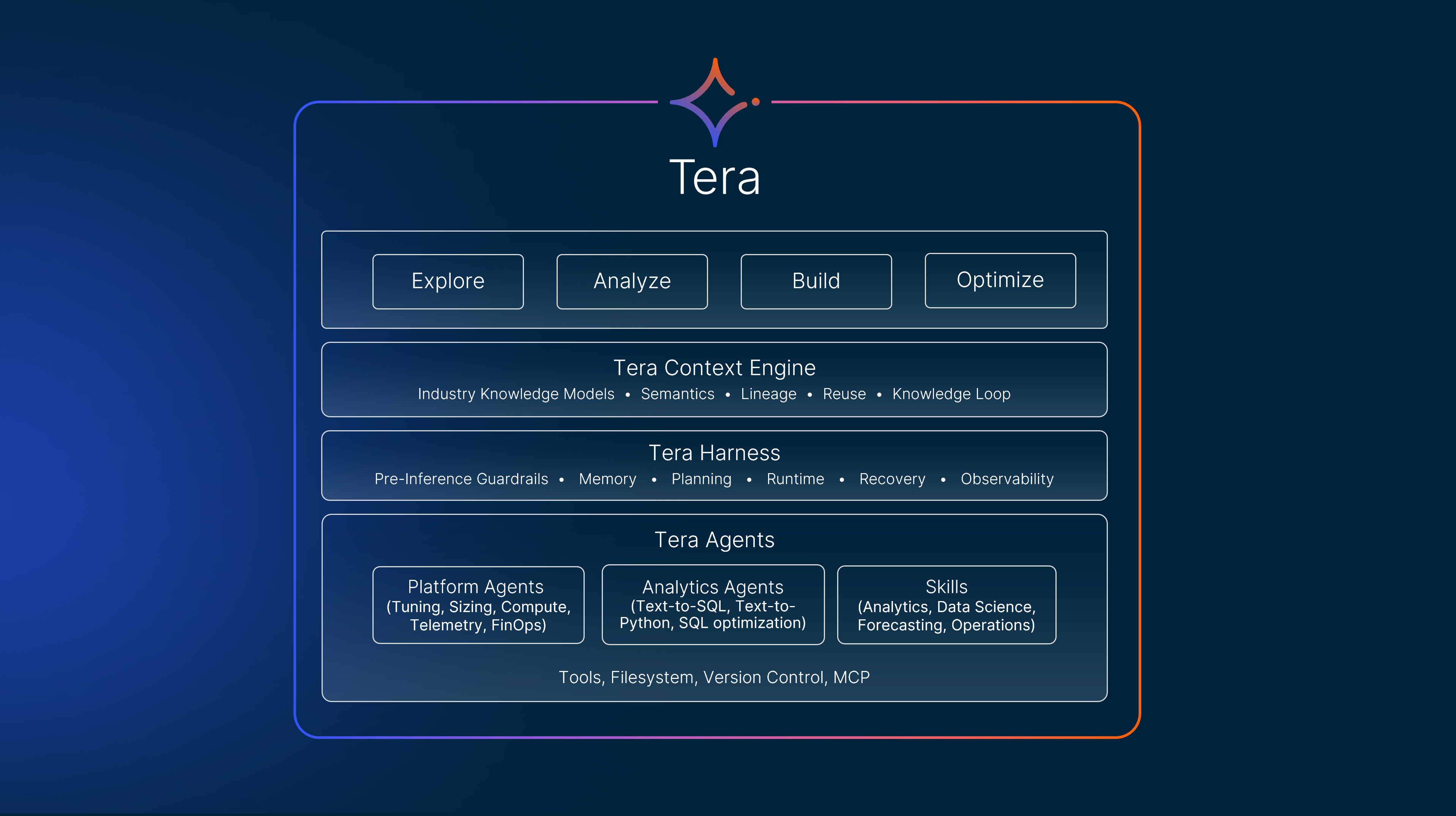
How Tera connects trusted enterprise knowledge to intelligent execution: Tera Context Engine provides governed business understanding, Tera Harness coordinates execution, and Tera Agents apply specialized enterprise expertise.
Tera is our agentic coworker for enterprise data work, designed to help teams move from questions and intent toward completed outcomes. Through natural language and purpose-built experiences, Tera can help users analyze data, develop code, build models and agents, work with the Teradata platform, and coordinate increasingly complex enterprise data and AI workflows. For example, Tera can take a natural-language question about customer behavior, identify the relevant data sources, write and validate the necessary SQL, run the analysis, and surface findings—without requiring the user to orchestrate each step manually. Rather than simply generating a response, Tera can use Tera Harness to orchestrate work across skills, tools, data, and models.
When Tera draws on trusted enterprise knowledge, the relationship between context and execution becomes especially powerful. Context can help determine what information means, which relationships matter, and which policies apply. And because that context is machine-interpretable, agents can do more than consume it—they can apply enterprise definitions, policies, standards, and controls as they participate in governed workflows. Tera Harness can use that understanding to help determine what needs to happen next, coordinate the appropriate capabilities, and govern how the work is executed.
That’s how we begin moving from AI that simply knows enterprise data toward AI that can understand the business and help accomplish meaningful work within it.
Turning context into action
Consider a bank trying to understand why a high-value customer segment is churning.
The necessary information might exist across transaction, product, service, digital engagement, and support systems. But the definitions of “customer,” “relationship,” or even “churn” may differ across those environments.
Tera Context Engine can connect those foundations and establish governed business meaning across them, applying relevant relationships, terminology, policies, lineage, and industry knowledge. Tera Harness can then use that context to coordinate the appropriate data, analytics, models, tools, and capabilities needed to investigate the problem and help move the analysis toward an actionable result. Tera brings those capabilities together through the agentic experience.
The same pattern can apply to investigating fraud across business lines, preparing regulatory reporting, developing healthcare AI models, or responding to supply-chain disruption.
The use cases differ. The underlying architecture is consistent:
Connect → Understand → Govern → Orchestrate → Execute.
From knowing your data to understanding your business
That is what we're building with Tera—bringing together Tera Context Engine, Tera Harness, and specialized agents to connect trusted enterprise knowledge with intelligent execution—and it reflects something larger about where enterprise AI is headed.
As agents become capable of executing increasingly complex work, the stakes of incomplete context rise. An AI system that answers a question based on missing context produces an incorrect answer. An AI system that acts based on missing context can create a far larger problem. The first era of enterprise AI was about making models more capable. The next era will be about making them more capable within the context of the enterprise—connected to the knowledge that makes an organization unique, and able to apply that understanding to real work.
That's what it means to activate enterprise intelligence. It's the difference between AI that knows your data and AI that understands your business.
And increasingly, competitive advantage will come not from AI that simply knows more, but from AI that understands how your business works—and can act accordingly. That is the shift from enterprise intelligence to enterprise action—and it is the foundation on which we are building the Autonomous Knowledge Platform.